
Writers’ Strikes Throughout History with James Schamus
In this episode of the WFF LET'S TALK FILM! Podcast, hosts Katy Mejia and Willis Williams chat with award-winning screenwriter James Schamus about fake unions created by Hollywood and the long history of the Writers' Strikes. James also provides insight into industry practices that prevent career stability for working writers + much more!
Schamus serves on the negotiating committee of the Writers Guild of America, whose members are currently on strike. Schamus is an award-winning screenwriter (The Ice Storm), producer (Brokeback Mountain), director (Indignation), showrunner (Somos.), former CEO of Focus Features, and won the Trailblazer Award at WFF in 2008. He is also Professor of Professional Practice in Columbia University’s School of the Arts, where he teaches film history and theory.
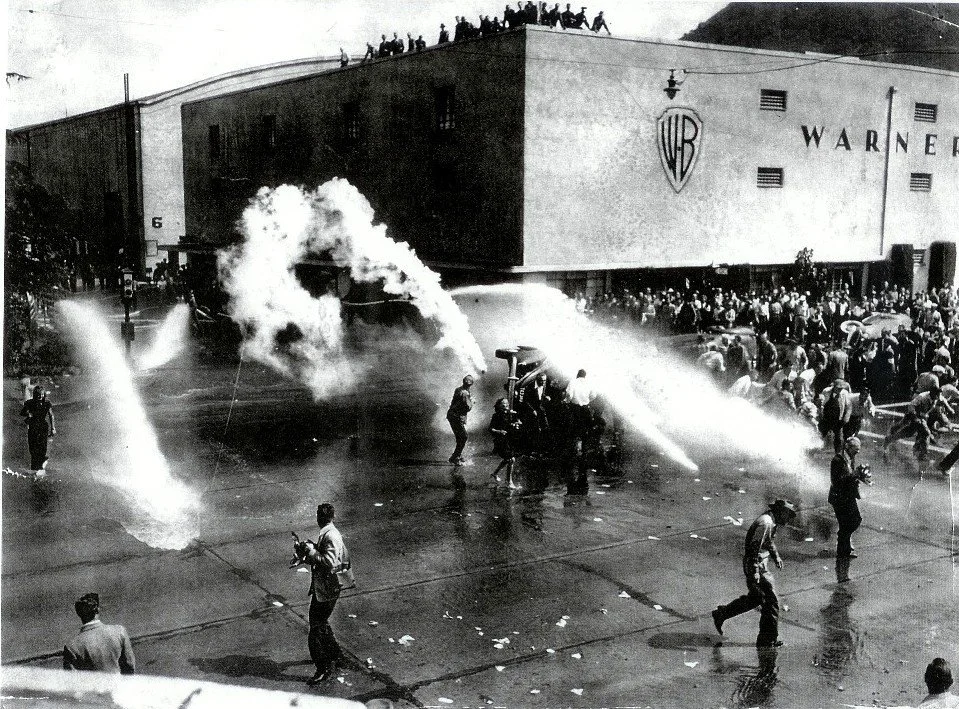
“The War for Warner Brothers” (1946)
Historically, writers' strikes are enacted when, during contract negotiations and by vote, the Writers Guild of America (WGA) fails to have their demands met by the Alliance of Motion Picture and Television Producers (AMPTP). In the podcast Schamus discusses the ‘Battle at Warner Brothers’ which occurred in the 1940s as Hollywood went on strike outside of the Warner Brothers’ office in Chicago. Because of this, Warner Brothers hired Chicago mobsters to run fake unions and antagonize the filmmakers on strike, which led to open fighting in the streets. These strikes eventually led to an agreement to define pay scales and script ownership rights while also allowing radio and theatrical writers to submit material for television.
The grievances of the WGA often have to do with pay (or lack thereof), defining their role in a changing business landscape, and/or standing up against conglomerates for their rights as professionals that need to sustain themselves and those who depend on them. For example, in the podcast, Schamus asserts that without strikes, the WGA wouldn’t have essentials like healthcare. Specific to this strike, the WGA calls for better residual (a type of royalty) pay, guidelines for artificial intelligence technologies, and more ethical conduct regarding mini rooms (a smaller version of a writer's room). The WGA argues that streaming has eroded the industry, worsening writing conditions and cutting writer's pay. And indeed, accounting for inflation, writer's salaries have decreased by 23% over the past decade. Additionally, Schamus emphasizes the “incredible shrinking” in time that television writers are employed to create seasons and a variety of issues regarding staffing for television.
In Schamus’s article published in The Guardian, "Hollywood Thinks it Can Divide and Conquer the Writers' Strike. It Won't Work." he claims that the conglomerates that writers answer to intend to use AI to "place (writers) deeper and deeper in indentured servitude." In the podcast, he states that one of the reasons the WGA is on strike is to negotiate the conditions in which finance capital deploys Artificial Intelligence (AI) and how it exacerbates the precarious nature of the positions of those who work under it, even threatening to fully replace background actors with AI simulations. In his article, Schamus points out that much like the exploited labor of writers scripting the films and shows viewers love and watch, AI "sit(s) atop a mountain of often hidden and unacknowledged human labor - labor that is overwhelmingly immiserated and exploited." Schamus refers to the labor of recently unionized content moderators based in Africa who are paid abysmally for the challenging and often traumatic job of training AI to ignore the dark depths of the internet. Schamus draws parallels between this group and his own, the WGA, with the closing statement, "Our strike, and their struggle, are joined together, and that struggle is not a battle between humans and machines, but rather a battle between humanity and capital. This round, I'm betting on humanity."
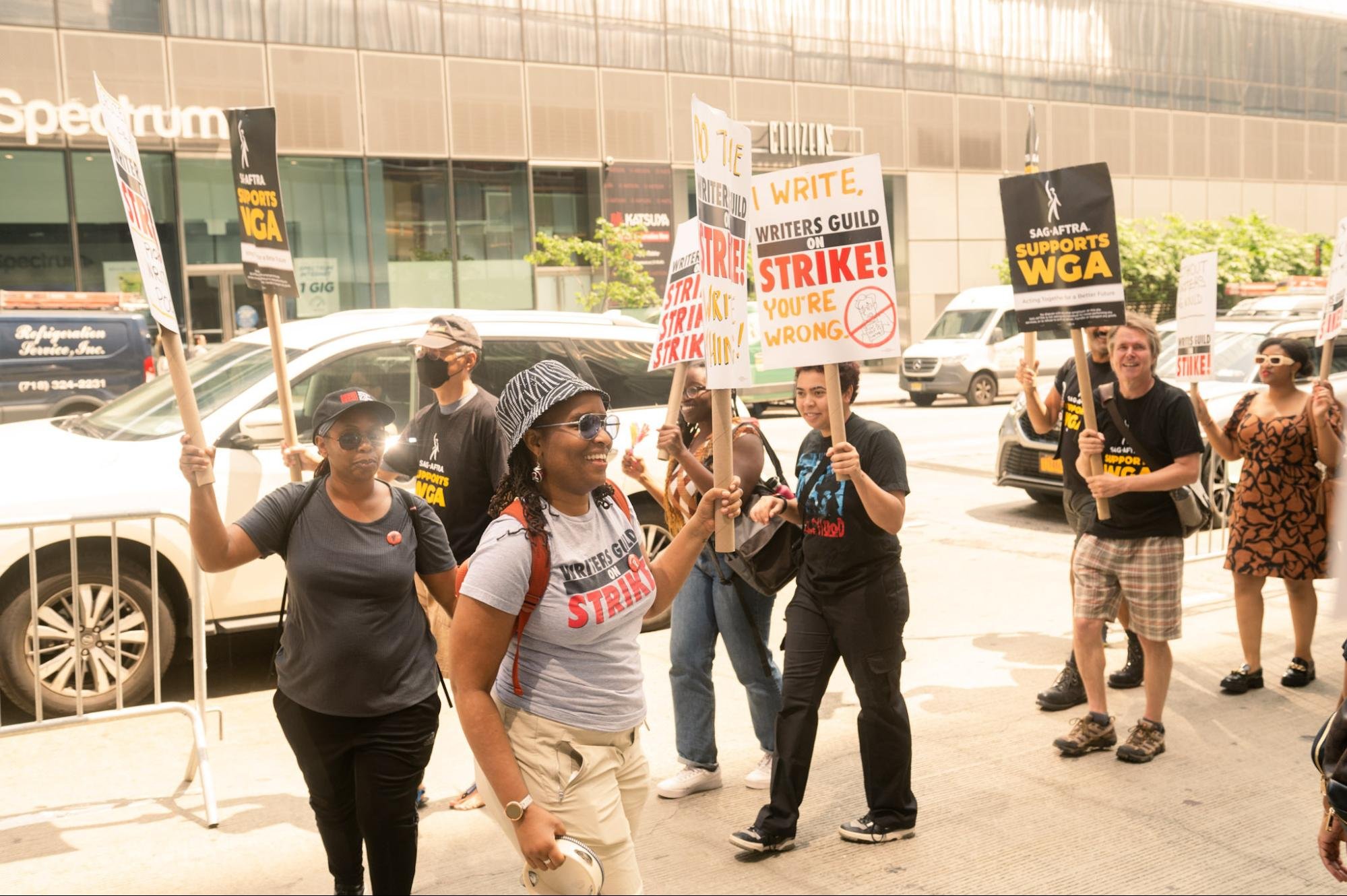
WGA on Strike (2023)
Shortly after the podcast was published SAGAFTRA ‘s contract negotiations collapsed and they were forced to strike. Their website states, “We’re up against a system where those in charge of multibillion-dollar media conglomerates are rewarded for exploiting workers. The companies represented by the Alliance of Motion Picture and Television Producers (AMPTP) — which include Amazon/MGM, Apple, Disney/ABC/Fox, NBCUniversal, Netflix, Paramount/CBS, Sony, Warner Bros. Discovery (HBO), and others — are committed to prioritizing shareholders and Wall Street. Detailed below are some of the key issues of the negotiation and where things stand. We moved on some things, but from day one they wouldn’t meaningfully engage on the most critical issues. “
CEO pay has skyrocketed 1,460% since 1978. CEOs were paid 399 times as much as a typical worker in 2021. One would think it would be appropriate for CEOs to offer a tiny percentage of their pay to resolve the contract issues with writers and actors, who, without them, Hollywood would be nothing.
The Woodstock Film Festival stands in solidarity with the members of The Writers Guild of America (WGA) and The Screen Actors Guild – American Federation of Television and Radio Artists (SAG-AFTRA) in their fight to secure fair compensation and ensure the protection of their crafts.